
When PR Stops Listening, Small Issues Become Big Crises
Public relations is often treated as the job of explaining an organization’s decisions after they are made. This week’s cases show why that approach can create even bigger problems. Across Adidas’ breakup with Ye, the Flint water crisis, Susan G. Komen’s Planned Parenthood controversy and Utah Tech’s rebrand, one major difference between stronger and weaker outcomes was whether leaders listened to stakeholders before communication became damage control. Effective PR is not just about creating the right message. It is also about helping organizations make better decisions in the first place.

Silence and Defensiveness Create Bigger Problems
The Adidas case shows that a delayed response can become a message of its own. Adidas initially stayed silent as Ye made antisemitic remarks, and the delay brought criticism from employees, consumers and other stakeholders before the company eventually ended the partnership (Ruiz et al., 2024).
The Flint water crisis shows an even more serious version of this problem. Officials repeatedly defended previous claims that the water was safe even as residents and outside experts raised concerns. Nowling and Seeger (2020) describe this as a failure of “sensemaking,” where officials became so committed to their existing position that they failed to properly recognize growing risks. Communication became focused on protecting the government’s reputation instead of solving the actual problem.
This connects with PRSA’s guidance on trust and transparency, which argues that organizations should communicate quickly and transparently while also listening to stakeholders during a crisis (Bermudez & Izquierdo, 2020). PRSA: Trust and Transparency in Times of Crisis
Stakeholders Can Change the Direction of a Crisis
Susan G. Komen’s decision to stop funding Planned Parenthood also demonstrates how quickly a policy issue can turn into a values crisis. Komen framed its new grant requirements as a standards-based decision, but many stakeholders viewed the change as politically motivated. Social media criticism grew rapidly, and Komen reversed its decision within days (Swann, 2019).
The lesson is not that organizations should change every decision because people complain. Instead, leaders need to understand how decisions will be interpreted by the people who trust, fund and represent their organizations. Pew Research Center identifies openness, integrity and accountability as important building blocks of public trust (Gecewicz & Rainie, 2019). Pew Research Center: Why Americans Don’t Fully Trust Many Who Hold Positions of Power and Responsibility
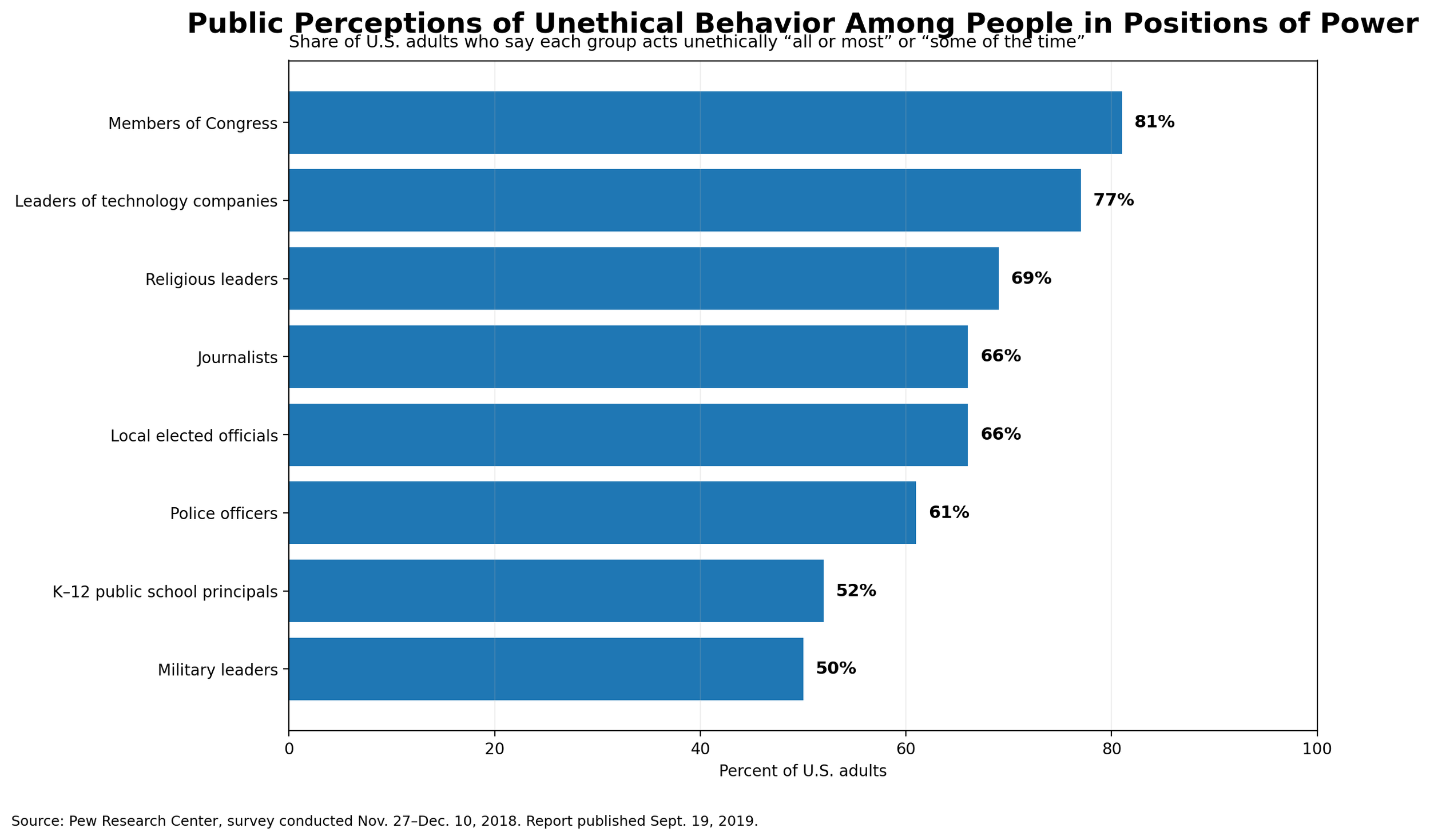
Public perceptions of unethical behavior among people in positions of power. Chart created using data from Pew Research Center (2019).
Research Makes Change Easier to Defend
Utah Tech offers a useful contrast. Rather than relying only on a top-down message, the university used surveys, focus groups, listening meetings, town halls and targeted outreach throughout its name-change process. Research showed that the Dixie name was negatively affecting areas such as enrollment, partnerships and alumni employment opportunities (Utah Tech University, 2023). Following the rebrand, the university reported increases in enrollment, involvement, donations and merchandise sales.
Together, these cases show that some of the strongest public relations work happens before the press release. PR practitioners should have a role in decision-making, risk assessment and stakeholder listening from the beginning. When organizations wait until a controversy explodes to involve communicators, even a polished response may be too late to protect trust.
References
Bermudez, H., & Izquierdo, A. (2020, July–August). Trust and transparency in times of crisis. Public Relations Society of America, Strategies & Tactics.
Gecewicz, C., & Rainie, L. (2019, September 19). Why Americans don’t fully trust many who hold positions of power and responsibility. Pew Research Center.
Nowling, W. D., & Seeger, M. W. (2020). Sensemaking and crisis revisited: The failure of sensemaking during the Flint water crisis. Journal of Applied Communication Research, 48(2), 270–289. https://doi.org/10.1080/00909882.2020.1734224
Ruiz, V., Rutter, M., & Anderson, J. (2024). Adidas says BYE: Adidas drops partnership with Ye. Arthur W. Page Society.
Swann, P. (2019). The politics of pink: Susan G. Komen for the Cure steps into partisan minefield. In Cases in public relations management: The rise of social media and activism (3rd ed., pp. 213–230). Routledge.
Utah Tech University. (2023). A small school elicits big change heard around the world. Public Relations Society of America.
Tags
Crisis Communication | Stakeholder Engagement | Public Trust | Issues Management | Corporate Responsibility