
Companies are expected more and more to respond to social issues, but simply posting a statement is not always enough. Audiences also pay attention to whether a company’s actions actually match what it says. This creates a difficult situation for public relations professionals because speaking up can strengthen relationships with some stakeholders while creating backlash from others. In fact, Pew Research Center found that Americans are evenly divided on whether companies making statements about political and social issues is important (Cheng & Horowitz, 2025). The cases from this week show that the bigger issue is not always whether a company speaks up, but whether its actions support the values it communicates.
Actions Make Advocacy More Credible
One of the biggest lessons from this week’s readings is that companies have to prove their values through action. Overton and Eng (2024) explain that expectations for businesses have changed as stakeholders increasingly expect organizations to take responsibility for social issues instead of only communicating their support.
The Disney case shows what can happen when stakeholders see a disconnect between a company’s stated values and its response to an issue. Disney initially remained publicly silent about Florida’s HB 1557 even though the company had previously emphasized inclusion. Employees pushed the company to take a clearer position, and Disney later publicly opposed the bill, apologized to employees and paused political donations in Florida (Djibo et al., 2023). The situation became more difficult because employees were already questioning whether the company’s actions matched the values it promoted.
Dick’s Sporting Goods handled its activism differently. After changing its firearm sales policies, the company prepared for criticism, publicly explained its reasoning and continued making changes to its business rather than stopping with a statement (Morris et al., 2020). The company knew the decision could create backlash but still connected the change to its broader values and brand story.
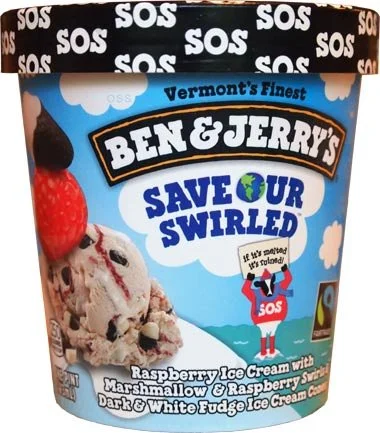
Ben & Jerry’s also shows how activism can become part of a company’s identity. Its “Save Our Swirled” climate campaign included partnerships, events, petitions, educational content and changes within the company itself (Epstein et al., 2018). Instead of only saying that climate change mattered, the company gave customers different ways to participate in the campaign.
Authenticity Has to Come First
Another important part of corporate activism is making sure a company’s response actually makes sense for the organization. Goldberg (2024) explains that companies should consider whether an issue connects to their mission and values before publicly taking a position. When there is a disconnect between what a company says and what it actually does, audiences may view the response as performative.
For PR professionals, I think the biggest takeaway is that there is no perfect statement that will satisfy every stakeholder. Companies do not necessarily need to comment on every issue, but when they choose to take a stand, their communication should match what they are actually willing to do. The Disney, Dick’s Sporting Goods and Ben & Jerry’s cases all show that people pay attention to what happens after a statement is made. If a company wants its advocacy to seem genuine, its actions have to support its words.
Keywords/Tags: Corporate Activism, Public Relations, Corporate Social Advocacy, Brand Authenticity, Stakeholder CommunicationReferences
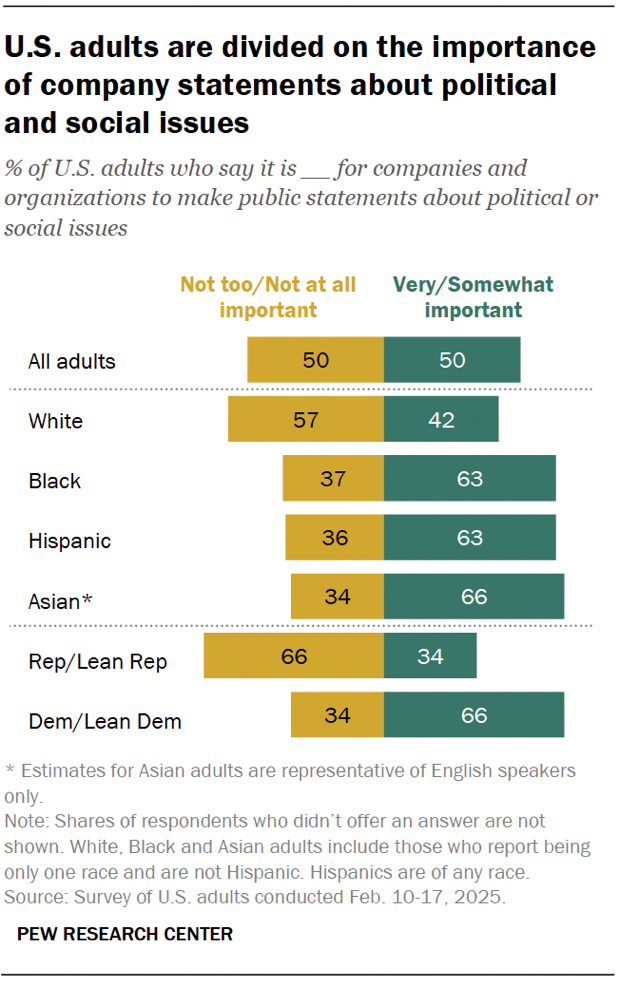
Figure 1. Americans are evenly divided on the importance of companies making public statements about political or social issues. Source: Pew Research Center (Cheng & Horowitz, 2025).
REFRENCES
Cheng, K., & Horowitz, J. M. (2025, August 5). Americans divided on whether companies should make statements about political, social issues. Pew Research Center.
Djibo, A., Estrada, M., Fisher, B., & Weinstock, K. (2023). Trouble in paradise: The Walt Disney Company’s response to Florida House Bill 1557. Arthur W. Page Society.
Epstein, C. B., Garcia, L., Kent, R. L., Podolin, J. L., & Jin, Y. (2018). Ben & Jerry’s sends out an S.O.S.: An analysis of Ben & Jerry’s global climate activism. Case Studies in Strategic Communication, 7, 1–35.
Goldberg, J. (2024, May). Deciding when to speak up on social issues. Strategies & Tactics.
Morris, A., Neuschwander, H., & Zhao, R. (2020). Dick’s Sporting Goods enters the gun debate: Revising the playbook. Arthur W. Page Society.
Overton, H., & Eng, N. (2024). Proving it with action: Embracing a responsibility to advocate for social change. In Public relations for public health and social good (pp. 166–180). Taylor & Francis.