
When Corporate Values Get Tested: Why CSR Has to Be More Than a Message
Corporate social responsibility can sound great on a company website, but this week’s readings made me realize that CSR means much more when a company actually has something to lose. Patagonia, CVS, Capital One and Tractor Supply all approached corporate responsibility differently, but together they show how closely a company’s actions become connected to its reputation. For public relations professionals, simply communicating that an organization has values is not enough. Stakeholders also pay attention to whether those values remain consistent when they become expensive, controversial or difficult to maintain.

Featured image: Illustration of business decision-making. Source: SweetProcess.
Values Matter Most When They Require Action
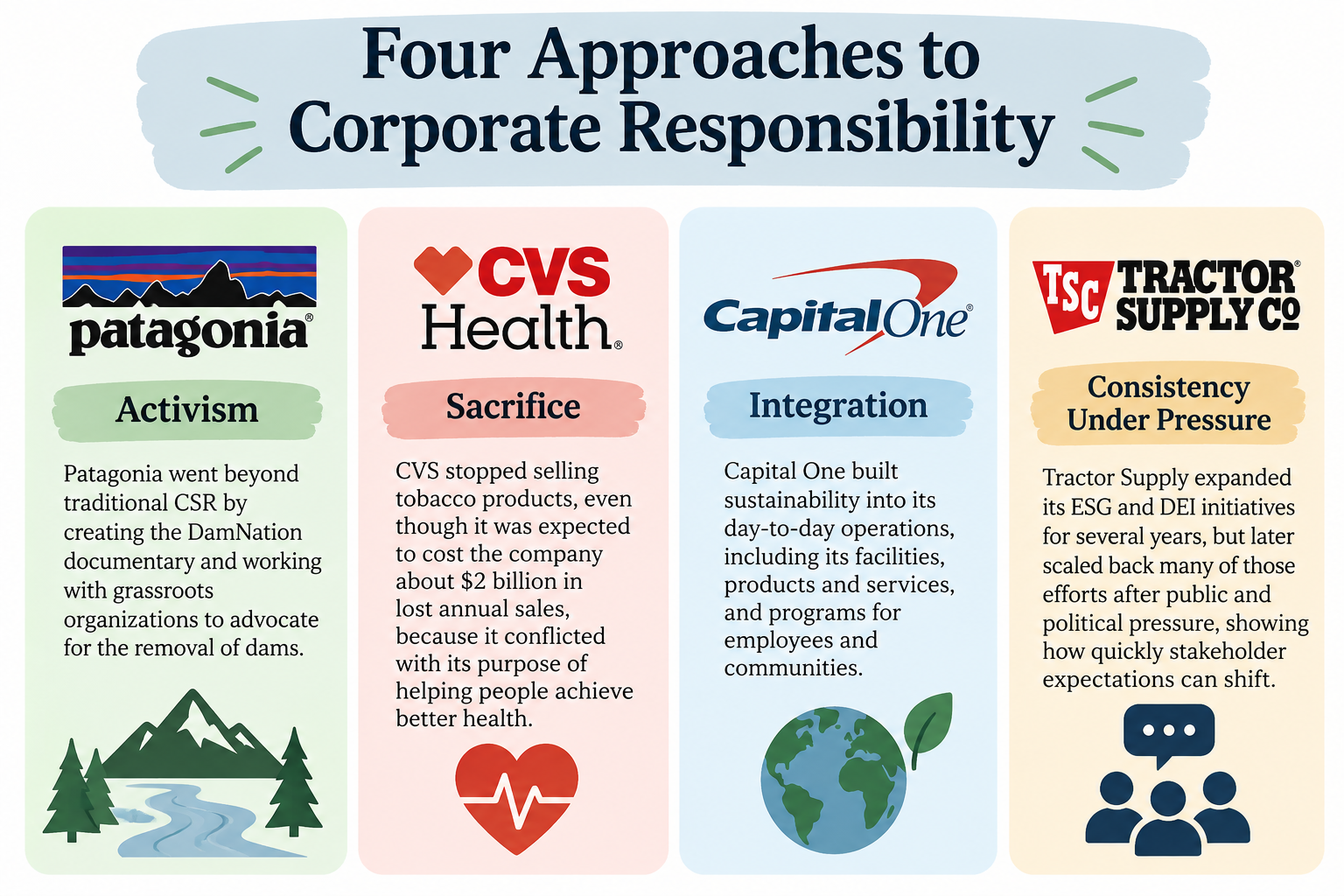
CVS is probably the clearest example of a company putting its stated purpose into action. In 2014, CVS stopped selling tobacco products because the company argued that selling cigarettes conflicted with its purpose of helping customers achieve better health. The decision was expected to cost approximately $2 billion in lost annual sales (Ward et al., 2016). CVS tobacco_CSR To me, the financial risk is what made the decision meaningful. It would have been much easier for CVS to promote healthier lifestyles while continuing to profit from tobacco.
Patagonia took corporate responsibility even further through its DamNation campaign. Instead of simply donating money to an environmental organization, Patagonia produced a documentary advocating for dam removal and worked with grassroots groups to encourage action. Moscato (2016) explains that this pushed Patagonia’s CSR closer to direct environmental activism. Patagonia_CSR
That connection between actions and values is still important for communicators today. PR Daily argues that CSR works best when it is part of an organization's identity rather than a temporary campaign. The article warns that companies can appear performative when their public statements are disconnected from what they actually do (Blackann, 2025). Read “3 Reasons Why CSR Policies Fall Short” from PR Daily
Consistency Builds — or Weakens — Trust
Capital One shows a less dramatic but equally important form of CSR. Its sustainability initiatives were integrated into several parts of the business, including operations, products and services, and programs for employees and communities (Smith, 2019). Rather than sustainability being one individual campaign, the case shows the importance of making responsibility part of everyday organizational behavior. Making plastic green_CSR
This made the Tractor Supply case especially interesting to me. For several years, the company publicly expanded its ESG and DEI efforts. The case documents an inaugural ESG report in 2020, expanded sustainability and DEI goals in 2021 and later recognition for workplace diversity. W6 Tractor supply case When Tractor Supply later reversed several of those initiatives after public pressure, the decision created a different kind of reputation challenge.
Tractor Supply is also part of a much larger corporate debate. The Associated Press has reported that multiple major companies have reduced or altered DEI programs amid political, legal and activist pressure. Read the Associated Press report on companies pulling back from DEI initiatives This shows why PR professionals have to consider more than whether a corporate position will receive positive attention in the moment. Organizations also need to consider what will happen if public opinion or outside pressure changes.
My biggest takeaway from these cases is that CSR creates expectations. Once a company tells employees, customers and communities what it stands for, those stakeholders will compare future decisions against those promises. Public relations can communicate corporate values, but communication cannot replace consistency. In the long run, the strongest CSR strategies seem to be the ones companies are actually prepared to stand behind.
Tags
Corporate Social Responsibility | Public Relations | Brand Reputation | Stakeholder Communication | Corporate Values
References
Blackann, C. (2025, June 10). 3 reasons why CSR policies fall short. PR Daily. PR Daily article
Moscato, D. (2016). The brand behind the activism: Patagonia’s DamNation campaign and the evolution of corporate social responsibility. Case Studies in Strategic Communication, 5, 99–116. Patagonia_CSR
Smith, S. A. (2019). Making plastic green: Capital One’s commitment to sustainability. Oxford University Press. Making plastic green_CSR
Ward, C. B., Roy, D. P., & Edmondson, D. R. (2016). Is CVS just “blowing smoke?”: Evaluating the CVS decision to ban tobacco products. Case Studies in Strategic Communication, 5, 249–264. CVS tobacco_CSR
Gone with the wind: Tractor Supply Co.’s rapid response to DEI backlash. (n.d.). Course case study. W6 Tractor supply case
The Associated Press. (2025). Which U.S. companies are pulling back on diversity initiatives? Associated Press article