
When Protecting a Reputation Becomes the Reputation Problem
Public relations professionals are often responsible for protecting an organization’s reputation, but this week’s cases show why reputation cannot be the first priority when people are being harmed. From institutional crises in sports to artificial intelligence in advertising, the larger lesson is that ethical communication requires organizations to address the problem itself rather than simply manage how the public sees it.
Silence Can Become Part of the Crisis
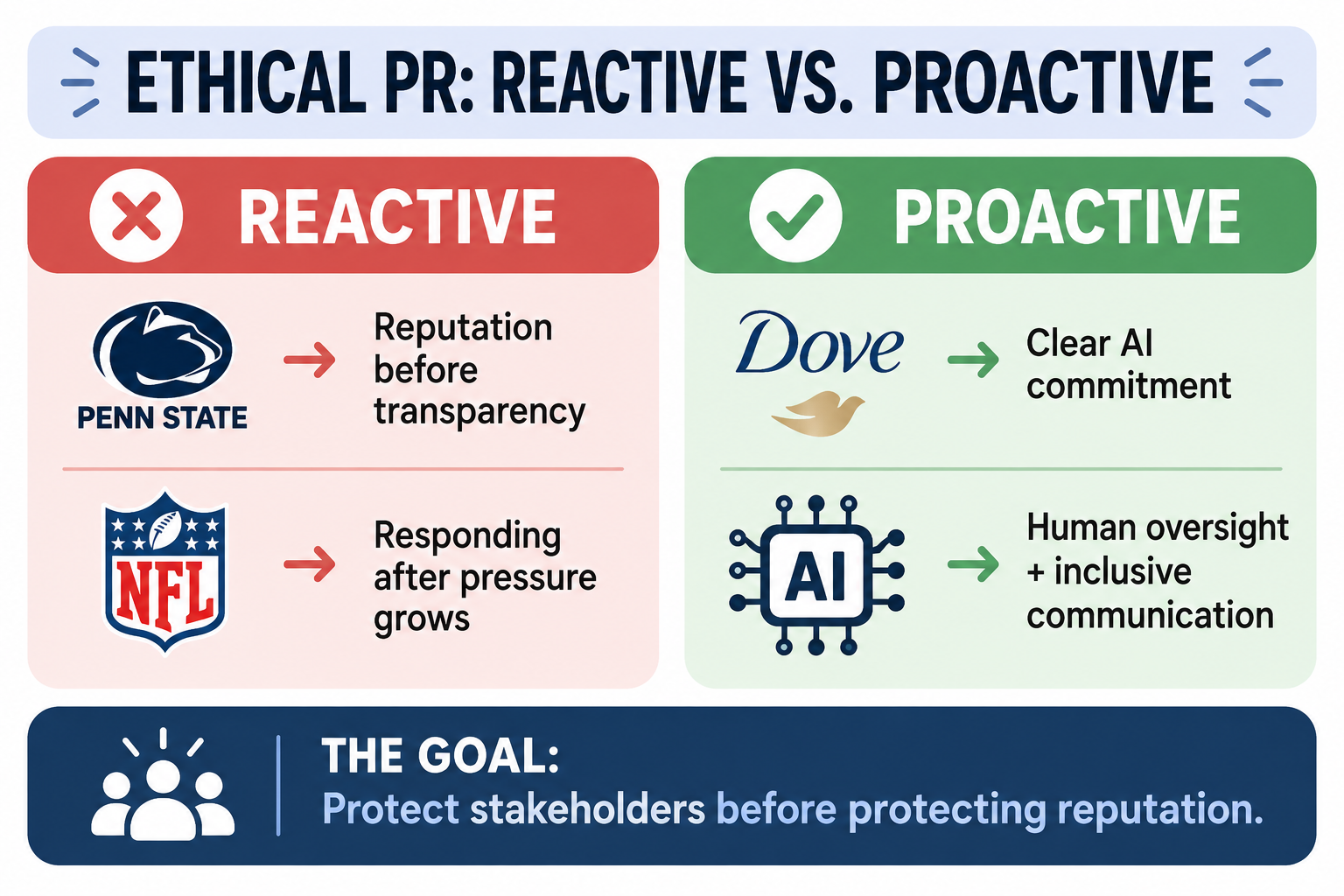
The Penn State and NFL concussion cases demonstrate what can happen when powerful organizations fail to confront harmful information early. In both situations, the problem became larger than the original issue because questions arose about what leaders knew, what they disclosed and whose interests they were protecting. The Penn State case especially shows how an institution’s culture and reputation can influence decision-making when leadership faces information that threatens a respected organization. Penn State Fumbles_ethics
The NFL concussion case raises a similar ethical issue. As evidence connecting football-related head trauma to long-term neurological damage increased, the league faced growing pressure over how it communicated the risks to players and the public. Concussions_ethics These cases reinforce an important PR lesson: withholding, minimizing or avoiding uncomfortable information may protect an organization temporarily, but it can create an even larger trust problem later.
That principle still matters in modern communication. The PRSA Code of Ethics emphasizes honesty, accuracy and disclosure of information because public trust depends on audiences having the information they need to make informed decisions.
AI Creates a New Version of an Old Ethical Problem

Artificial intelligence may seem completely different from the Penn State or NFL controversies, but the ethical challenge is surprisingly similar: communicators still have to consider who could be harmed by the systems they use.
Mattiazzi’s research found gender bias in both textual and visual AI outputs. For example, Google Translate associated certain professions with gender stereotypes, while Canva-generated images reproduced traditional gender roles. W7 AI and language W7 AI and language The problem is especially important for PR because communicators increasingly use AI to create messages and visuals that can influence how audiences understand people and society.
Dove’s #KeepBeautyReal campaign offers a contrasting approach. Rather than waiting for AI-generated beauty standards to become a reputational crisis, Dove connected the issue to its existing Real Beauty values and pledged not to use AI to create or distort images of women. W7 Dove keepbeautyreal in the a… That consistency matters because effective corporate advocacy should be supported by actual organizational behavior, not simply a campaign slogan.
The issue matters to audiences too. Pew Research Center found that 55% of both the public and AI experts are highly concerned about bias in AI decision-making. Pew Research Center PRSA similarly warns that AI can reproduce human biases and argues that transparency and human oversight are necessary to maintain trust.
Ultimately, technology may change, but the responsibility of public relations professionals does not. Ethical PR means asking more than, “How will this affect our reputation?” It means asking, “Who could be affected by this decision, and are we being honest with them?”
Tags: Public Relations Ethics, Artificial Intelligence, Crisis Communication, Corporate Responsibility, Reputation Management
refrences
Pew Research Center. (2025, April 3). How the U.S. public and AI experts view artificial intelligence.
Pew Research Center article
Ewing, M. E. (2023, September). Navigating ethical implications for AI-driven PR practice. Public Relations Society of America.
PRSA article